
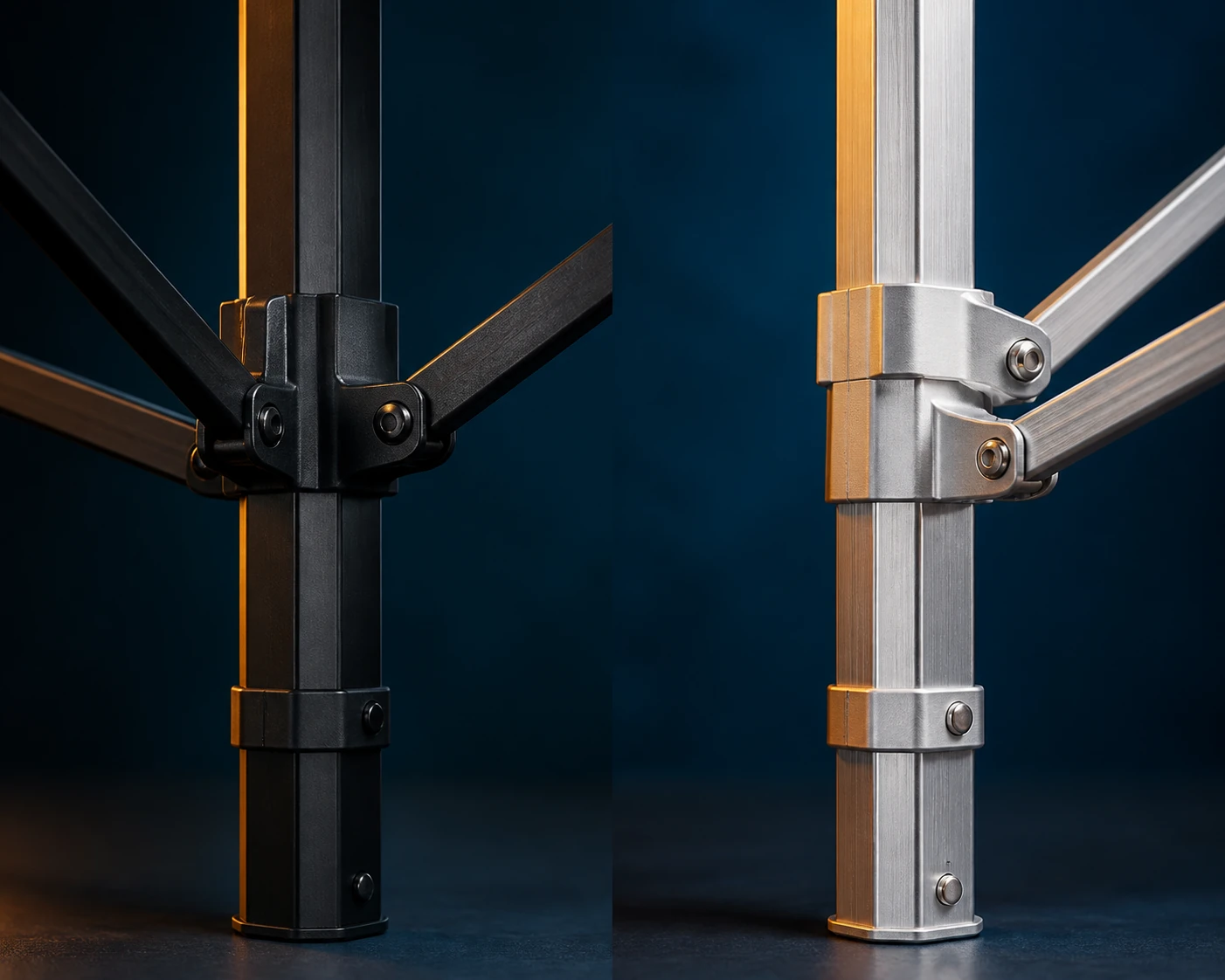
Illustrative material detail. Compare the exact model, tube geometry, wall thickness, joint design, accessories and anchoring in the RFQ.
A like-for-like lens
Start with the frame weight—then specify the complete system.
These listed 3 × 3 m frame weights make the transport discussion tangible. They do not describe the weight of the roof, walls, accessories or packed canopy.
Steel · listed 3 × 3 m frame
A value-focused steel comparison point.40 mm steel · listed 3 × 3 m frame
The heavier listed steel frame in this like-for-like view.Aluminum · listed 3 × 3 m frame
The lowest listed frame weight in this comparison.Listed frame weights are comparison inputs, not a certification or all-weather performance claim. Confirm the final configuration before order approval.
When steel fits
Choose BST when commercial value is central. Compare THI when buyers want a thicker 40 mm platform for repeated handling.
When aluminum fits
Choose ALU when lifting, vehicle loading and corrosion resistance matter. Confirm the trade-off against cost and the desired feel of the frame.
Use like-for-like comparisons
Compare the same footprint and include roof, walls and accessories separately. The frame weights published here are catalogue frame weights, not complete packed-system weights.
Frequently asked questions
Is aluminum always weaker than steel?+
Material name alone does not prove system strength. Tube geometry, wall thickness, connectors, design and testing also matter.
Which 10 × 10 ft frame is lightest?+
The listed ALU-33 frame is 9.10 kg, compared with 15.00 kg for BST-33 and 18.20 kg for THI-33.